Trace
Trace runs the model on your text and records what happens in every layer.
It needs a build with the trace feature:
Example
LAYER  |h|    COS(in,out)  LOGIT LENS (top-5)
0      7.5    0.2959       " is" 1.00  " was" 0.00 ...
...
10     139.1  0.8817       "olit" 0.04  "polit" 0.02  " capitals" 0.01 ...
11     140.3  0.9130       " Rome" 0.35  " capitals" 0.07  " Naples" 0.04 ...
13     143.4  0.9279       " Rome" 0.85  " Venice" 0.02  " Milan" 0.02 ...
15     69.4   0.5629       " Rome" 0.84  " not" 0.03  " a" 0.03 ...
next token: " Rome" 0.838
The columns
| Column | Meaning |
|---|---|
\|h\| |
size of the model's internal state after the layer |
COS(in,out) |
how similar the state is before and after the layer. Close to 1 means the layer changes little, which makes it a removal candidate |
ATTN ENTROPY |
how spread out attention is (low means each word looks at a few others) |
TOP NEURONS |
the feed-forward neurons that fired the most |
LOGIT LENS |
what the model would answer if it stopped at this layer |
The same view in the web interface (trace tab), here for qwen3:8b. " Rome" only appears at layer 29, and the final prediction is " Rome" 0.825:
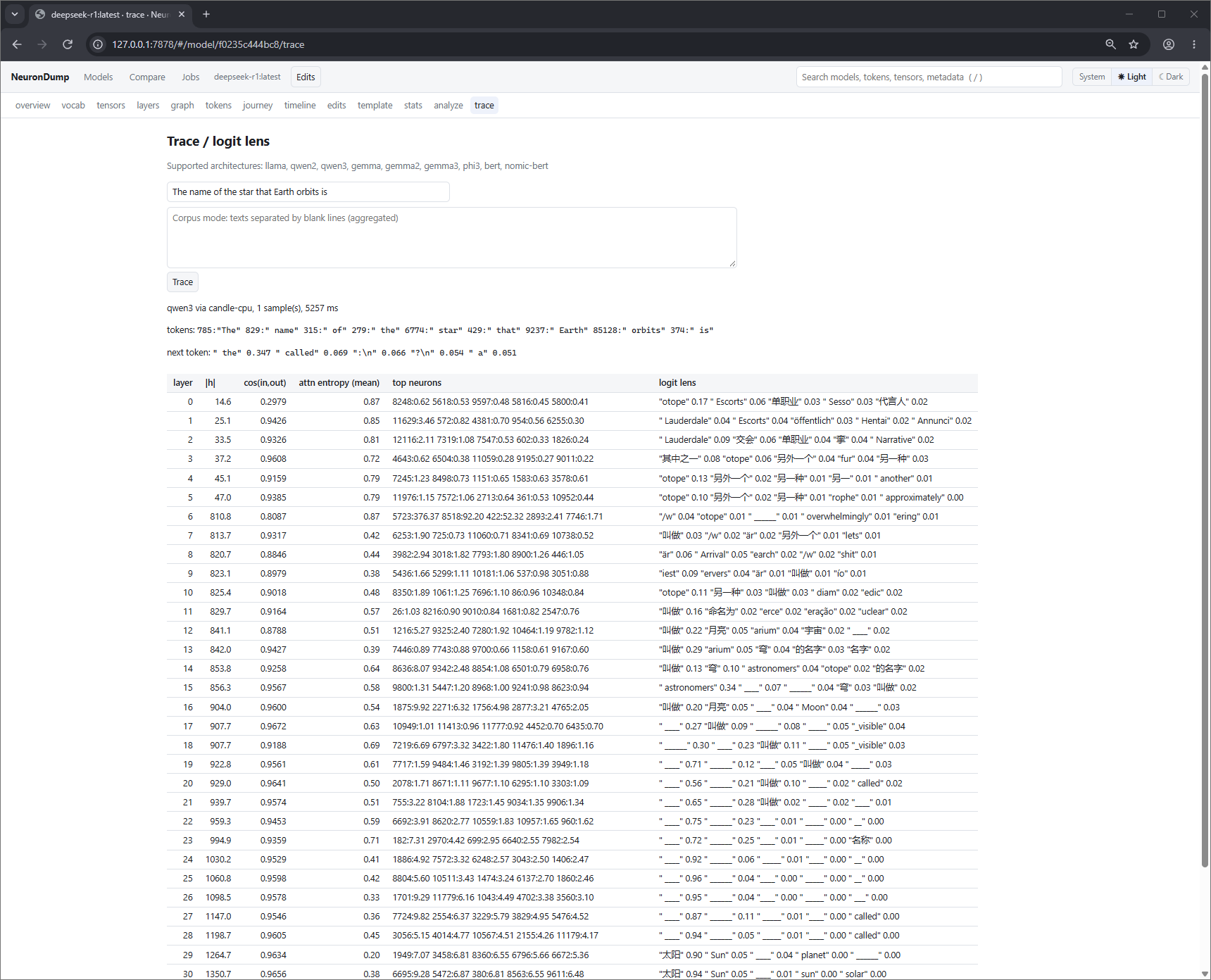
In the llama example the model "knows" the answer at layer 11: that's where " Rome" first appears. By layer 13 it is sure (0.85).
Several texts
Values are averaged over all texts. The result is saved, and the next analyze uses it to
rank which layers can be removed.
Embedding models
For models like nomic-embed-text, there is no next token. Instead, trace shows how much each
input token contributes to the final embedding.
Supported architectures
llama, qwen2, qwen3, gemma, gemma2, gemma3, phi3, bert, nomic-bert.
Other models (for example hybrid Qwen 3.5) report "trace unsupported". All the other commands still work on them. Tracing runs on the CPU and loads the whole model into memory: an 8B model at 4 bits needs about 5 GB of RAM.